This presentation meeting is a venue for students to share various community contribution activities, and this year, a total of 19 universities and technical colleges participated.
This presentation session serves as a platform for students to share their diverse community service activities. This year, 19 universities and technical colleges participated.
Additionally, I was able to interact with students involved in various fields such as agriculture, sports, calligraphy, and music, gaining new inspiration and learning opportunities.🌱
引き続き、地域とともに歩む活動を進めてまいります!
We will continue to advance our activities alongside the community!
The HUAG (Hiroshima University Architecture Group) course “Architectural Seminar II” offers third-year students an opportunity to experience research-lab activities. In our laboratory, under the theme “Techniques for Planning the Regeneration of Architectural Spaces,” students worked on a project to reinterpret the shopping center inside the Motomachi Apartment Complex in central Hiroshima as a spatial resource and to propose feasible plans for its renewal.
The seminar students assigned to the laboratory visited the Motomachi high-rise apartment complex on Saturday, October 18. They then revisited the apartment complex on Saturday, November 29, where they presented their final revitalization plan proposals, developed in groups, at the rooftop community center. Ideas included “Art Space Formation,” “Motomachi Expo,” and “Community Kitchen + Children’s Cafeteria + Community Café.” The groups demonstrated a clear understanding of the complex’s issues, and some even used generative AI for logo design—showing creativity beyond faculty expectations.
Ms. Itai, who embodies multiple roles including artist, graduate student, resident, and community leader, offered warm and realistic comments on each presentation. Her multifaceted perspective was invaluable.
Afterward, all participants held a small gathering at the okonomiyaki restaurant Soei inside the shopping center. Over food, we reflected on the workshop and discussed future possibilities. The lively conversations and delicious okonomiyaki helped deepen our connections. I myself enjoyed a pork–egg–soba okonomiyaki topped with natto and green onions—so excellent.
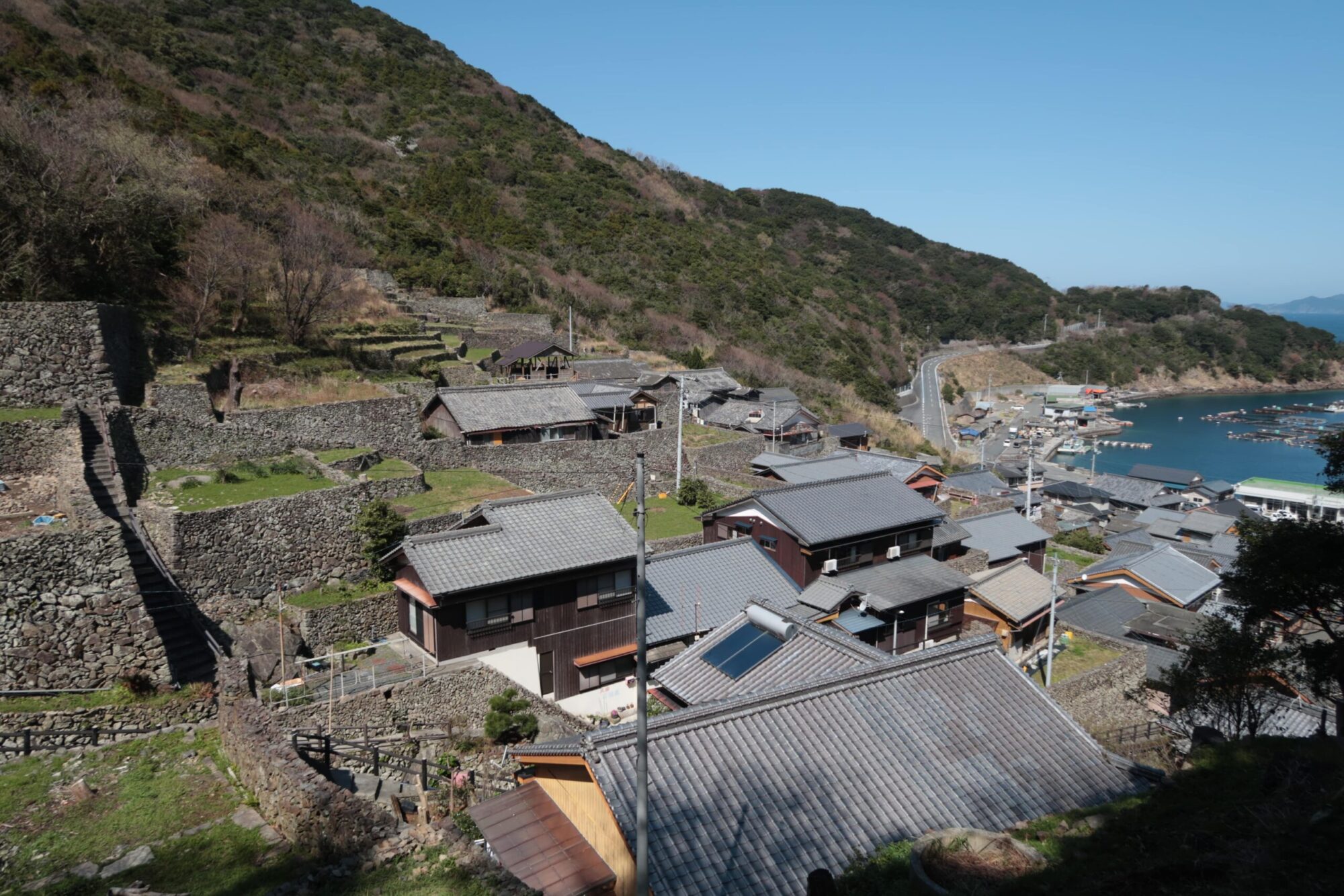
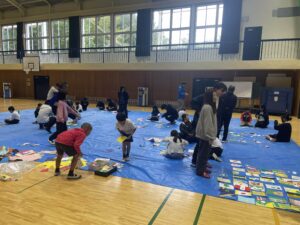
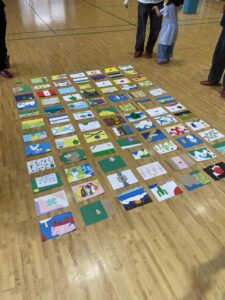
On the first day, we joined a workshop at Sagiura Elementary School, where we enjoyed creating our own “personal national flags” together with the children and students who had gathered from across Japan and around the world. After the workshop, we lined up all the unique and expressive pieces and took a commemorative photo. It was an inspiring time that allowed us to interact closely with both the children and the students.
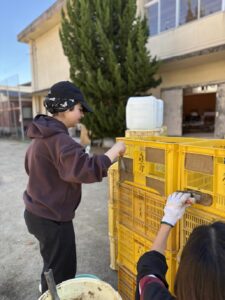
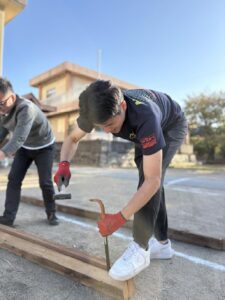
On the second and third days, we explored the island and worked on creating a mock-up of an earthen wall. There were many things we saw and experienced for the first time, making it a highly educational opportunity. In between activities, we also removed nails from dismantled materials in preparation for upcycling. I’m very excited to see how these materials will be transformed in the future!
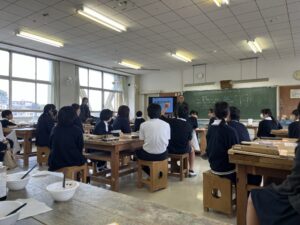
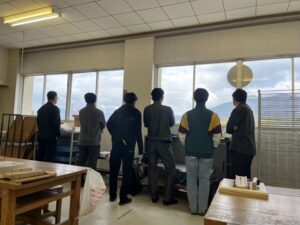
On Tuesday, November 18, we held an off-campus workshop at Yasu-higashi Elementary School, where students experienced making their own wooden chopsticks.
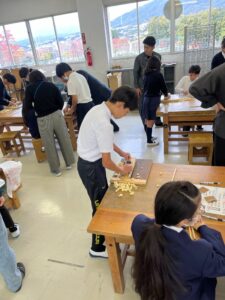
After Mr. Sumikura’s talk on architecture, timber, and the work of carpenters, the sixth-grade students tried using a kanna (hand plane) to shave the wood and craft their chopsticks.
We university students also assisted the children together with members of the construction company, supporting them as they worked hard to handle the hand plane and shape their very own chopsticks.
Watching them use the hand plane, smooth the wood with sandpaper, and carefully finish every detail with dedication was truly wonderful and left a lasting impression on us.
We hope that this experience will inspire the children and help broaden their learning and future possibilities.
We participated in the second workshop for the ABW Office Transformation Project with The Chugoku Electric Power Co., Inc. EnerGia Comprehensive Research Institute on November 6!
Following the previous session, teams of employees and students exchanged ideas on “current issues to be improved” and “our vision of an ideal office.” Participants brought in photos representing the kind of workplace they would like to work in, created collages, and shared their images with the group. Each team wrapped up the session with a presentation of their concepts.
The next workshop will feature cross-team discussions. We look forward to seeing what new ideas will emerge!
Graduate students from our laboratory participated in a Japan–China Joint Design Workshop organized by Dalian University of Technology, Dalian Minzu University, and Hiroshima University.
This year’s assignment was to design the preservation and renewal of the houses and residential area in Bunka Street in Dalian, which were developed and supplied by a Japanese company in the first half of the 20th century.
Although the theme was quite challenging, students from both countries worked collaboratively and successfully compiled their results. There were several interesting planning and design proposals, but more importantly, I believe it was a wonderful experience for the students to interact with peers from a neighboring country—thinking together, overcoming differences in language, customs, and culture, and arriving at a shared solution.
We are now friends across neighboring countries, and I sincerely hope they will keep in touch and cultural exchanges in the future.
Starting this fiscal year, we’ve launched a project to upcycle wooden furniture surplus from Yano Minami Elementary School due to declining enrollment, and preparations are steadily progressing!
On November 6th, we actually disassembled wooden desks and chairs at Yano Minami Elementary School to be used for upcycling! After watching a demonstration by Sakura Saku, a furniture shop, four students from our lab attempted to disassemble chairs. It proved more difficult than imagined, and we struggled quite a bit…
Since the project will involve elementary school students and university students working in groups to dismantle the furniture, we students want to train hard to ensure we can dismantle smoothly!!
After dismantling the furniture, we discussed future plans. We were able to talk about the project’s direction and a rough schedule, making it a very productive time.
It’s already been one month since I started studying abroad in the Philippines.I feel this term is shorter than I expected. At first, I was worried about my English skills for not being able to speak English well. Although I made a lot of mistakes while talking in English, I was sure that my English was getting better through conversations. But still, I can’t pronounce like a native speaker, so I will keep on practicing so that I can communicate with foreigners more smoothly.
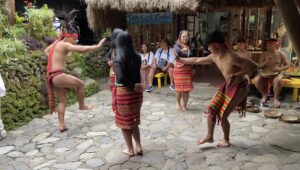
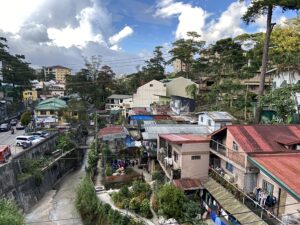
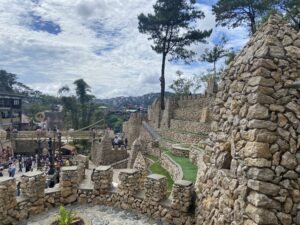
By the way, I’d like to introduce the spots I visited. I came across various sightseeing spots and experienced a variety of foods and diverse cultures. For example, there was a traditional dance in Baguio. I saw it, and I was impressed with it. There were also traditional houses, and they were terrific. Moreover, I went to the Igorot Stone Kingdom, where I could see a nice view of Baguio City.
Traditional Dance in BaguioLocal Houses in BaguioThe Igorot Stone Kingdom
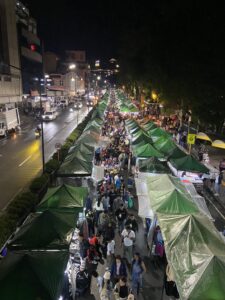
Especially, the night market was wonderful. It was held in the park and on the road in front of the park from 9 pm to 2 am. I ate balut for the first time. Before eating it, I was scared because I wasn’t used to seeing it, but once I attempted to eat it, I felt that it tasted good. My wallet was almost empty because I spent too much money on trying foods and buying clothes.
The Night Market in Baguio
I have four weeks left. Therefore, I will make an effort so that my studying abroad goes well.
.jpeg)
.jpeg)
.jpeg)
.jpeg)

.jpeg)
.jpeg)


.jpeg)
.jpeg)

.jpeg)
.jpeg)
.jpeg)
-1.jpeg)
.jpeg)
(大).jpeg)
.jpeg)
.jpeg)
.jpeg)